© 2012 Joshua Stark
Yesterday and between storms, me and the kids planted up one of our raised beds. Starting West and moving East: pole beans, corn, okra, swiss chard, okra, nasturtium (edges), cabbages (edges), cherry tomatoes (North), beefsteak tomatoes (South), poblano peppers (North), early jalapeños (South), basil.
Ruben, the eighteen-month old, was the catalyst for the plantings. Day-before-yesterday the little elf, famous in this house for throwing everything he can into the pond, had gotten hold of my package of basil seeds and tossed it in the drink. Since they'd soaked for a while, I decided it would be best to just plant the whole packet - something I never do (I still have seeds from five years ago). Frankly, it was kinda cathartic, and I knew it was time to get the rest of the stuff in, too.
I hate thinning plants that I've planted and that have shown the courtesy to come up, so my gardens always look a bit anemic because I'm afraid to over-plant. Not this time. I planted many, many seeds. We'll see if I'll be callous enough to do the dirty work and thin the babies, although I probably will do what needs to be done and just eat them, anyway.
The bed is 4' x 8', and I'm sure I'm straining somebody's take on companion planting (tomatoes with corn), but let me explain myself. We have three raised beds, and this year the Upper Bed was planted early with greens, onions and leeks (and now garlic, too). Agnes asked for the North Bed, which I was tickled pink to give her. In it we've put lemon balm, cilantro, marigolds, and more garlic, and we still have some room.
The one bed left, then, was "my" vegetable garden, and it all needed to go in. So I started with pole beans and corn on the Northeast side to minimize garden shading. I know that corn and beans don't get along with tomatoes, so I put in some okra (which supposedly gets along with everybody) and chard (which is always just happy to be here) in-between. I edged everything with nasturtium (yes, I'm 30 years late to the party, but I don't care, I love a plant I can grow that tastes just like black pepper). On the West side are rows of cherry and beefsteak tomatoes, poblanos and jalapeños (not jalapenos - and never, ever make that mistake when typing about Spanish years), and finally the infamous row of basil.
I'm afraid that the latest storm will slow down the peppers and tomatoes; I'd rather not buy flats of started plants this year, but instead get some good show from these seeds. Our Spring temps. usually shoot up 20 or 30 degrees the day after a storm, so I'm not too worried, but you never know. I hope to use some of the cherry tomato seedlings to fill a hanging garden bag my Mother-in-law gave us a couple of years ago, but I will buy a started pear tomato if they don't show.
Speaking of hanging gardens, we also put a Rutgers heirloom tomato in an upside-down tomato bag (complete with pretty metal stand). The stand was my Christmas present from one of my lovely sisters, and it looks great!
Around the property, the cuttings are showing no additional signs of life, but the pomegranate, orange, fig, currant and boysenberries are definitely thriving.
Consider me your experiment for getting your entire vegetable garden in one bed. I'll do my best to keep you posted.
----------
On the dog front, more crappy news. The local SPCA turned us down over the phone because the dog I was interested in (a "lab/hound mix" which looks awfully like a lab/GSP mix) was not, according to them, good for a home with children. Apparently, the reasoning goes, she "jumps up a lot." B.S. I told the lady that it was too bad they were prejudiced against children instead of taking the time to get to know the potential owner, and hung up. I suppose they've never met a person who could train a dog not to jump up - and I'd like to know if they've ever had a medium-sized or larger dog under the age of two not jump up. According to the Sacramento SPCA, then, kids shouldn't be raised around big dogs. I don't know what they are trying to accomplish, but building a constituency of people who love dogs enough to want to save them obviously isn't one of them.

Showing posts with label plant updates. Show all posts
Showing posts with label plant updates. Show all posts
Thursday, April 12, 2012

Friday, July 22, 2011
Update: Around the garden and yard (tip!), pickling, and looking for ideas
© 2011 Joshua Stark
Well, it looks as if my latest attempt to keep the ducks out of the raised bed (give 'em one bed, and fence the other with five-foot bamboo trellis) is proving successful, but I wonder if it's only because they are getting older and care less about thwarting me. Whatever the reason, I'm getting a late batch of corn, beans and possibly okra - I'm especially excited about the beans. I wish I had pictures for you all, but our camera was stolen from our car a couple of weeks back (along with my fly rod)...
The potato patch (described here) isn't working as I'd hoped - I only see one potato trying to grow, and it doesn't look like it can work its leaves through the bamboo sun-shade I'm using. However, I'm still hopeful, and the plants I put in on top are still coming up, too. They aren't looking too healthy, but this is a learning process, and next time I plan to layer some good soil from the worm bin in-between layers of straw.
My lawn experiment is also coming along nicely. When I built our little duck pond last year, I inadvertently killed the majority of our lawn. You see, I used the dirt from the pond to in-fill the lower sections of the yard, but I didn't really believe that the dirt below the topsoil was sterile. Boy, was I wrong on that one.
Gratefully, the ducks have been fertilizing that dirt for the past year. However, our very hard rains this year turned much of it into durn-near cement (if you put the emphasis on the first "e" in cement, you will pronounce that properly), and I, having no intention of renting a roto-tiller just to find out where my sprinkler lines are, started looking for a short-cut. This time, to my surprise, I found one:
First, I mowed down the straw used by the ducks. Then, I soaked the yard really good. Next, I spread grass seed (by hand, of course - if I'm not renting a rototiller, I'm sure as heck not buying a seeder!), then covered them in a layer of mulched straw, and watered that down. Every day for the first few days I sprayed the patch, and now, two weeks later, my test patch looks nice and green! A couple of days back, when I saw that the grass had established, I raked up the larger straw, and I'll be danged if it doesn't look like we have grass on our lawn.
Of course, the ducks couldn't leave it alone, and there are a couple of holes (especially right where the sprinkler pops up), but those can be fixed with extra seed or a patch of sod. Overall, I'm tickled pink at how well this worked.
I also finally got around to dealing with my ketchup walnuts. Instead of the nine days soaking in vinegar, I actually soaked them for over two weeks, and I must say that the vinegar became even darker than I'd remembered. I wasn't too worried, though, since vinegar just gets better with age, and nothing was going to start growing in that acidic and tannic concoction.
Yesterday, I drained out the vinegar into a stock pot, put in some ingredients (drat! I forgot the horseradish), and about 30 minutes later, I canned four pints of green walnut ketchup.
I then crushed the walnut chunks (I had a lot), added four apples and a cup of raisins, then some surgar and spices, and made up four pints of chutney, with a little left over for last night's dinner.
Both recipes can be found at my "Green Walnuts & You" page. I added allspice and cinnamon to the chutney, and it is something special. If you've ever had store-bought chutney, homemade blows it away - so long as you use good vinegar. It is smoother, much less sharp, yet still vinegary in a good way. I could have added some more heat in the form of more cayenne, but then my wife wouldn't have liked it nearly as much. For dinner last night, the chutney and some yogurt made wonderful fillips for a split pea soup.
Well, it looks as if my latest attempt to keep the ducks out of the raised bed (give 'em one bed, and fence the other with five-foot bamboo trellis) is proving successful, but I wonder if it's only because they are getting older and care less about thwarting me. Whatever the reason, I'm getting a late batch of corn, beans and possibly okra - I'm especially excited about the beans. I wish I had pictures for you all, but our camera was stolen from our car a couple of weeks back (along with my fly rod)...
The potato patch (described here) isn't working as I'd hoped - I only see one potato trying to grow, and it doesn't look like it can work its leaves through the bamboo sun-shade I'm using. However, I'm still hopeful, and the plants I put in on top are still coming up, too. They aren't looking too healthy, but this is a learning process, and next time I plan to layer some good soil from the worm bin in-between layers of straw.
My lawn experiment is also coming along nicely. When I built our little duck pond last year, I inadvertently killed the majority of our lawn. You see, I used the dirt from the pond to in-fill the lower sections of the yard, but I didn't really believe that the dirt below the topsoil was sterile. Boy, was I wrong on that one.
Gratefully, the ducks have been fertilizing that dirt for the past year. However, our very hard rains this year turned much of it into durn-near cement (if you put the emphasis on the first "e" in cement, you will pronounce that properly), and I, having no intention of renting a roto-tiller just to find out where my sprinkler lines are, started looking for a short-cut. This time, to my surprise, I found one:
First, I mowed down the straw used by the ducks. Then, I soaked the yard really good. Next, I spread grass seed (by hand, of course - if I'm not renting a rototiller, I'm sure as heck not buying a seeder!), then covered them in a layer of mulched straw, and watered that down. Every day for the first few days I sprayed the patch, and now, two weeks later, my test patch looks nice and green! A couple of days back, when I saw that the grass had established, I raked up the larger straw, and I'll be danged if it doesn't look like we have grass on our lawn.
Of course, the ducks couldn't leave it alone, and there are a couple of holes (especially right where the sprinkler pops up), but those can be fixed with extra seed or a patch of sod. Overall, I'm tickled pink at how well this worked.
I also finally got around to dealing with my ketchup walnuts. Instead of the nine days soaking in vinegar, I actually soaked them for over two weeks, and I must say that the vinegar became even darker than I'd remembered. I wasn't too worried, though, since vinegar just gets better with age, and nothing was going to start growing in that acidic and tannic concoction.
Yesterday, I drained out the vinegar into a stock pot, put in some ingredients (drat! I forgot the horseradish), and about 30 minutes later, I canned four pints of green walnut ketchup.
I then crushed the walnut chunks (I had a lot), added four apples and a cup of raisins, then some surgar and spices, and made up four pints of chutney, with a little left over for last night's dinner.
Both recipes can be found at my "Green Walnuts & You" page. I added allspice and cinnamon to the chutney, and it is something special. If you've ever had store-bought chutney, homemade blows it away - so long as you use good vinegar. It is smoother, much less sharp, yet still vinegary in a good way. I could have added some more heat in the form of more cayenne, but then my wife wouldn't have liked it nearly as much. For dinner last night, the chutney and some yogurt made wonderful fillips for a split pea soup.
Friday, September 24, 2010
Cutting back
© 2010 Joshua Stark
I have trouble cutting back in many ways. Ask my wife, and she'll say I can't pass up a "free" craigslist posting, and I have too many seeds and kitchen gadgets. However, this post is about cutting back old plants to make way for the new plantings.
I babied a terrible patch of corn and beans this year, to the detriment of their bed-mates (squashes and cucumbers), because I kept detecting the potential for great reproduction. The corn never grew more than 40 inches or so, and of the 15 plants, we harvested about one-half of an ear. But, the corn was the trellis for the green beans, since I like growing the three sisters together (corn, beans & squash), and the green bean plants, after a slow start, looked lush. So I kept them on, even though I saw only a couple of flowers on the vines through much of the Summer.
Then, about mid August, I decided I'd had enough. There was some grey wilt on the squashes, but my reticence toward actively working the bed had led to an aversion for the space - I just didn't want to work in it, because I knew it would entail giving up on the patch of corn & beans. However, this aversion, coupled with the thickness of the patch, had allowed the wilt to impact my zucchini crop. I headed over to the patch, and found dozens of flowers on the beans. Great! And, crap! My resolve thoroughly crushed, I let them stand.
I harvested maybe about 8 beans. Meanwhile, my zucchini and cucumbers never recovered from the wilt.
Last week, I yanked the patch of beans and corn, and cut back my other plants. I'll give the squashes and cukes one more week, and then the whole patch gets root veggies and alliums.
Next time, I'll know to be more direct in gutting those that aren't making it. I've got worm bins and ducks who are more than happy to compost the lot, so it won't be a total loss... it's just so hard to cut back.
I have trouble cutting back in many ways. Ask my wife, and she'll say I can't pass up a "free" craigslist posting, and I have too many seeds and kitchen gadgets. However, this post is about cutting back old plants to make way for the new plantings.
I babied a terrible patch of corn and beans this year, to the detriment of their bed-mates (squashes and cucumbers), because I kept detecting the potential for great reproduction. The corn never grew more than 40 inches or so, and of the 15 plants, we harvested about one-half of an ear. But, the corn was the trellis for the green beans, since I like growing the three sisters together (corn, beans & squash), and the green bean plants, after a slow start, looked lush. So I kept them on, even though I saw only a couple of flowers on the vines through much of the Summer.
Then, about mid August, I decided I'd had enough. There was some grey wilt on the squashes, but my reticence toward actively working the bed had led to an aversion for the space - I just didn't want to work in it, because I knew it would entail giving up on the patch of corn & beans. However, this aversion, coupled with the thickness of the patch, had allowed the wilt to impact my zucchini crop. I headed over to the patch, and found dozens of flowers on the beans. Great! And, crap! My resolve thoroughly crushed, I let them stand.
I harvested maybe about 8 beans. Meanwhile, my zucchini and cucumbers never recovered from the wilt.
Last week, I yanked the patch of beans and corn, and cut back my other plants. I'll give the squashes and cukes one more week, and then the whole patch gets root veggies and alliums.
Next time, I'll know to be more direct in gutting those that aren't making it. I've got worm bins and ducks who are more than happy to compost the lot, so it won't be a total loss... it's just so hard to cut back.
Monday, August 23, 2010
Weather and roasted tomatoes
© 2010 Joshua Stark
The strange weather in Northern California has brought some strange gardening. For example, I don't think we've seen one day over 105 this year, and although the National Weather Service says Sacramento has had eight days over 100, I only remember one hot weekend.
Our days have been in the 80's mostly, with a smattering of 90's. This is not 'normal' - Sacramento usually sees 22 days over 100 degrees in a Summer.
This is my excuse for four-foot corn plants and tomatoes that get a pale orange color when ripe, and the ten or so green beans we harvested from a dozen plants put in the ground.
And this week will continue a strange weather year, starting with temps at around 100 for two days, and then dropping down into the mid 80's... what are we supposed to do with this?
This morning, my daughter Phoebe and I had decided to pull the green-but-not-producing bean plants, along with the old corn stalks, and start planting greens for Fall. Hank's pak choy and other assorted greens are looking quite lovely, and I think we could get a couple of harvests of young pak choy in, as well as start maybe some garlic and cabbages.
But when we looked into the green beans, we saw flowers! And, one tiny bean, which I picked for Phoebe. So, the beans stay, getting a makeshift prop-up from some camphor tree limbs I cut last week. Hopefully with this week's hot snap, we'll see more beans.
The tomatoes, though not the prettiest, have been producing just fine the past few weeks, and I've started looking for recipes for them beyond just eating them off the plant.
I'm no fan of tomatoes (gasp!), which my wife finds funny, because I'm no fan of eggs (gasp!) or zucchinis (gasp!), either, but I grow them at home in great quantities. I'll eat them, and I love them all as valuable ingredients, don't get me wrong, but I don't much care for them in their purer states. This fact, coupled with my plethora of tomatoes this year, is the reason for the searching online.
Because I'm no fan of tomatoes (ga... oh, never mind), what I found was new to me, but may not be so to you all. I found oven roasted, oven dried, or slow roasted tomatoes, and what I've found I very much like.
The recipe I used this time, though there were many good-looking ones, was adapted from Julie Biuso's, because it had the shortest cooking time at one hour, and with the expected high temperatures, I'd like to keep the oven off. I say 'adapted', because I didn't use small tomatoes, I used big tomatoes (an heirloom variety about the size of a better boy) and canning tomatoes (an heirloom that bears a striking resemblance to romas, only longer). I put some basil on some, cut some tomatoes thicker and others thinner, and then taste-tested.
One of my reasons for not fancying tomatoes is the acid - it's too much for me - so after each bite, I would swish some baking soda water around in my mouth, which seemed to do the trick.
My favorite is the thicker slice with some basil on it:

It could have used some more cooking time, for sure - next time I'll try 90 minutes, instead of one hour. In the meantime, consider my version of an easy cooking method that yields a divine tomato:
Tomatoes, sliced about 1/4 inch thick
Salt
Black Pepper
Fresh basil
Olive oil
Lay out sliced tomatoes, sprinkle chopped fresh basil, salt, and black pepper. Drizzle with olive oil. Cook 'til done. Look for curled, slightly blackened edges, and a thicker, not-quite-fruit-leathery texture. Enjoy.
If you have any suggestions, ways to garden in the weird weather or ideas to make those oven-roasted tomatoes even snappier, please let me know.
The strange weather in Northern California has brought some strange gardening. For example, I don't think we've seen one day over 105 this year, and although the National Weather Service says Sacramento has had eight days over 100, I only remember one hot weekend.
Our days have been in the 80's mostly, with a smattering of 90's. This is not 'normal' - Sacramento usually sees 22 days over 100 degrees in a Summer.
This is my excuse for four-foot corn plants and tomatoes that get a pale orange color when ripe, and the ten or so green beans we harvested from a dozen plants put in the ground.
And this week will continue a strange weather year, starting with temps at around 100 for two days, and then dropping down into the mid 80's... what are we supposed to do with this?
This morning, my daughter Phoebe and I had decided to pull the green-but-not-producing bean plants, along with the old corn stalks, and start planting greens for Fall. Hank's pak choy and other assorted greens are looking quite lovely, and I think we could get a couple of harvests of young pak choy in, as well as start maybe some garlic and cabbages.
But when we looked into the green beans, we saw flowers! And, one tiny bean, which I picked for Phoebe. So, the beans stay, getting a makeshift prop-up from some camphor tree limbs I cut last week. Hopefully with this week's hot snap, we'll see more beans.
The tomatoes, though not the prettiest, have been producing just fine the past few weeks, and I've started looking for recipes for them beyond just eating them off the plant.
I'm no fan of tomatoes (gasp!), which my wife finds funny, because I'm no fan of eggs (gasp!) or zucchinis (gasp!), either, but I grow them at home in great quantities. I'll eat them, and I love them all as valuable ingredients, don't get me wrong, but I don't much care for them in their purer states. This fact, coupled with my plethora of tomatoes this year, is the reason for the searching online.
Because I'm no fan of tomatoes (ga... oh, never mind), what I found was new to me, but may not be so to you all. I found oven roasted, oven dried, or slow roasted tomatoes, and what I've found I very much like.
The recipe I used this time, though there were many good-looking ones, was adapted from Julie Biuso's, because it had the shortest cooking time at one hour, and with the expected high temperatures, I'd like to keep the oven off. I say 'adapted', because I didn't use small tomatoes, I used big tomatoes (an heirloom variety about the size of a better boy) and canning tomatoes (an heirloom that bears a striking resemblance to romas, only longer). I put some basil on some, cut some tomatoes thicker and others thinner, and then taste-tested.
One of my reasons for not fancying tomatoes is the acid - it's too much for me - so after each bite, I would swish some baking soda water around in my mouth, which seemed to do the trick.
My favorite is the thicker slice with some basil on it:

It could have used some more cooking time, for sure - next time I'll try 90 minutes, instead of one hour. In the meantime, consider my version of an easy cooking method that yields a divine tomato:
-------------------------------------------
Oven Roasted Tomatoes Tomatoes, sliced about 1/4 inch thick
Salt
Black Pepper
Fresh basil
Olive oil
Lay out sliced tomatoes, sprinkle chopped fresh basil, salt, and black pepper. Drizzle with olive oil. Cook 'til done. Look for curled, slightly blackened edges, and a thicker, not-quite-fruit-leathery texture. Enjoy.
If you have any suggestions, ways to garden in the weird weather or ideas to make those oven-roasted tomatoes even snappier, please let me know.
Saturday, May 15, 2010
What's coming together, and what needs to be done...
In the backyard, that is.
Well, here's a pic. of the pond that has been taking an inordinate amount of my time - plus the raised beds and other projects either in the works, or on the list:

First, the raised beds are all built, except for the potato bed, which is only half-built (it's the pile of straw on the left edge of the picture). The pond edge is done, too, except for some rock-filling. The back fence has been cleared of ivy, and I've planted the sierra currant and put some other flowers back there with it. The boysenberries (on the trellis next to the grass bin) just need watering, and though you can't see them, the pomegranate is bright with big flowers, reminiscent of a flamenco dancer's dress.
The pond still needs a water feature (to appear on its left side in the pic). The raised beds, boysenberry and pomegranate need their irrigation dug (the black pipe coming out of the pond). The workshop in the background needs to be cleaned out (the remains of my huge mistake of storing walnuts in there last Winter), and the lawn needs to be seeded. Last, I need to add plants to my raised beds. Any suggestions?
Well, here's a pic. of the pond that has been taking an inordinate amount of my time - plus the raised beds and other projects either in the works, or on the list:

First, the raised beds are all built, except for the potato bed, which is only half-built (it's the pile of straw on the left edge of the picture). The pond edge is done, too, except for some rock-filling. The back fence has been cleared of ivy, and I've planted the sierra currant and put some other flowers back there with it. The boysenberries (on the trellis next to the grass bin) just need watering, and though you can't see them, the pomegranate is bright with big flowers, reminiscent of a flamenco dancer's dress.
The pond still needs a water feature (to appear on its left side in the pic). The raised beds, boysenberry and pomegranate need their irrigation dug (the black pipe coming out of the pond). The workshop in the background needs to be cleaned out (the remains of my huge mistake of storing walnuts in there last Winter), and the lawn needs to be seeded. Last, I need to add plants to my raised beds. Any suggestions?
Friday, March 5, 2010
March in California
© 2010 Joshua Stark
Just a few pictures from yesterday:
Boysenberries coming to life -


The pomegranate coming to life -

And the cedar against the beautiful sky -

Just a few pictures from yesterday:
Boysenberries coming to life -


The pomegranate coming to life -

And the cedar against the beautiful sky -

Sunday, August 30, 2009
Sometimes things work out just like the book says!
A quick post: My earlier attempt at growing corn and pole beans together ended poorly... don't grow an early variety of corn with your pole beans, especially if you ultimately have a mild Summer. My corn grew stunted (poor soil), and died early, leaving my beans with little support for the rest of the year. However, I planted a second round, and they took together nicely. Here's a pic:
 And, a closeup of the crop:

Very exciting stuff!
 And, a closeup of the crop:
Very exciting stuff!
Wednesday, July 29, 2009
Stuff I've learned
Just a quick compilation of ideas for next year, before I forget them:
1. Pole beans climb well on river reed, just keep the smaller branches on the reed;
2. Pole beans climb well on corn, but make sure you plant the corn at the right time, and use slower growing corn, so it won't die out well before the beans;
3. Re-grade the whole garden to allow for better water flow;
4. Raised beds!;
5. Have a pile of soil for mounding that is easily available;
6. Tomatoes go on the NorthEast side of the garden.
Good for now.
On another note, my ducks have so completely and effectively eaten bugs in our backyard, that they are having more trouble foraging, and are now eating more of the food we buy them. What they have left are what look like leafhoppers, and houseflies, and I think it's because those two are too fast for them. A glance at our porch light at night reveals the brutal effectiveness of our three ducks. Almost nothing comes to flutter at the light...
1. Pole beans climb well on river reed, just keep the smaller branches on the reed;
2. Pole beans climb well on corn, but make sure you plant the corn at the right time, and use slower growing corn, so it won't die out well before the beans;
3. Re-grade the whole garden to allow for better water flow;
4. Raised beds!;
5. Have a pile of soil for mounding that is easily available;
6. Tomatoes go on the NorthEast side of the garden.
Good for now.
On another note, my ducks have so completely and effectively eaten bugs in our backyard, that they are having more trouble foraging, and are now eating more of the food we buy them. What they have left are what look like leafhoppers, and houseflies, and I think it's because those two are too fast for them. A glance at our porch light at night reveals the brutal effectiveness of our three ducks. Almost nothing comes to flutter at the light...
Sunday, July 26, 2009
Nocino onto its second step, and a garden query
 © 2009, Joshua Stark
This is my first year experimenting with making preserves of one kind or another, and yesterday was time to open up the jar of green walnuts, cinnamon, lemon peel, cloves, sugar, sparkling wine and vodka that had been steeping on my back porch, and filter out the liquid into a new container.
flx1247rg
Here's a pic of the process, just a cheesecloth over an old kimchi jar (a korean market around here sells them for 79 cents each!). I did this on the grass, because I'm overly afraid of the legends of the staining abilities of walnuts!
Anyhoo, my concerns were (mostly) allayed upon opening the jar, when I caught scent of the aroma... of course, alcohol-y, but also sweet and deep. Steeped green walnuts smell like food, and I am now very excited to wait the next 6-24 months recommended by the instructions...
I will actually break this open for drinking next Spring, just as the green walnut season gets started. If it is good, then I will commence to making much, much more (I have access to quite a few green walnuts).
I also took the solids, and added 3/4 cup of brandy, and the rest of the sparkling wine to it. I'm told it makes a second, less-potent liquoer. However, I forgot the sugar in that recipe, so I'll have to break that one open today.
Now, my garden question: It seems all of my peppers are doing remarkably well, except my bell pepper, which wilts a'la my cukes and zukes...
 It's the pepper in the middle. Any suggestions? The two on either side are a jalapeno and a sweet wax (which has made some big, but nearly tasteless, peppers).
Saturday, July 25, 2009
Getting back on the blog horse
After a few weeks off, I'm trying to get back into regular posting.
So here are some notes on gardening:
Duck water (what my brother-in-law refers to as "nutrient-rich water") is an amazing product on the garden. If only I could bottle it... okay, that's gross, but really, most of my vegetable garden plants look absolutely gorgeous...
with the two notable exceptions of leafy greens, which the ducks have completely wiped out, and the cucumber, which, though large and flowering, still wilts in the Sun. I doubt I'll get cukes this year, either, but I'm trying a few things. First, I'm feeding it potting soil fairly regularly. Second, I'm removing a number of flowers, the idea being that the plant can put its energy into growing fruit. We'll see.
The first crop of corn, planted too early, has died out (and only grew about three feet tall, too). The second planting is receiving healthy doses of duck water, and is responding very vigorously, as are the beans, planted at the same time. My sweet 100 and pear tomato fruits are gargantuan, and those two plants are not only huge, but also poorly placed. Next year, I will move them to the Northeast side of the garden.
Which brings me to my last observation: I have learned a ton this year, even though my harvests have been tiny (except in tomatoes). Next year, I know how I will trellis my pole beans, I know where I'll place things, I know how I will build my raised beds (pretty high, as ducks have long necks). I have a whole new idea about soil, and I have a great watering system, which I'll write about later. I know a lot more about season (don't be fooled by warm weather in February). I started off the earlier harvest disappointed in my garden, but the last couple of weeks I have realized how much of a learning process this is, and I feel much better about it.
Also, my tomatoes are huge.
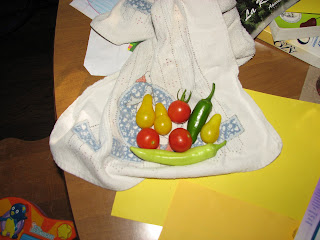
So here are some notes on gardening:
Duck water (what my brother-in-law refers to as "nutrient-rich water") is an amazing product on the garden. If only I could bottle it... okay, that's gross, but really, most of my vegetable garden plants look absolutely gorgeous...
with the two notable exceptions of leafy greens, which the ducks have completely wiped out, and the cucumber, which, though large and flowering, still wilts in the Sun. I doubt I'll get cukes this year, either, but I'm trying a few things. First, I'm feeding it potting soil fairly regularly. Second, I'm removing a number of flowers, the idea being that the plant can put its energy into growing fruit. We'll see.
The first crop of corn, planted too early, has died out (and only grew about three feet tall, too). The second planting is receiving healthy doses of duck water, and is responding very vigorously, as are the beans, planted at the same time. My sweet 100 and pear tomato fruits are gargantuan, and those two plants are not only huge, but also poorly placed. Next year, I will move them to the Northeast side of the garden.
Which brings me to my last observation: I have learned a ton this year, even though my harvests have been tiny (except in tomatoes). Next year, I know how I will trellis my pole beans, I know where I'll place things, I know how I will build my raised beds (pretty high, as ducks have long necks). I have a whole new idea about soil, and I have a great watering system, which I'll write about later. I know a lot more about season (don't be fooled by warm weather in February). I started off the earlier harvest disappointed in my garden, but the last couple of weeks I have realized how much of a learning process this is, and I feel much better about it.
Also, my tomatoes are huge.

Sunday, May 17, 2009
The Good News/Bad News post
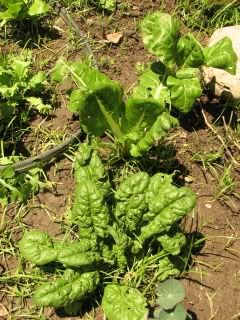
Good News: My spinach and greens, well actually most everything in the garden, is taking off -
Bad News: My swiss chard languishes in the Sun and doesn't keep in the fridge...
If you have any suggestions for getting my chard to perk up, please let me know. It isn't for a lack of water.
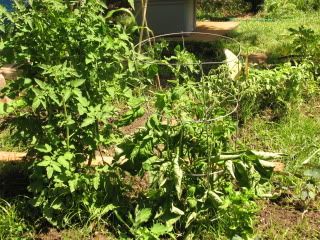 Good news: My tomatoes are about five feet high
Bad news: My brandywine's largest leaves are curling, and it doesn't look like it'll be very prolific:
Let me know if you think I should plant another tomato to take its place... Will it produce early and then die, or keep producing through the Summer?
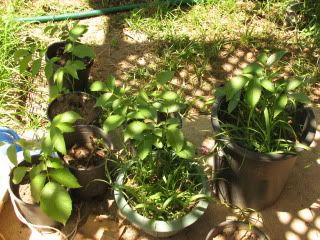
Good news: Our potted walnuts, babies from our 65 foot tree, look really great!
Bad news: Nobody wants them :( I've tried posting them to Craigslist, but I get the impression that the only people asking about them wanted dozens. Maybe next year...
If you are interested in a walnut tree, please let me know.
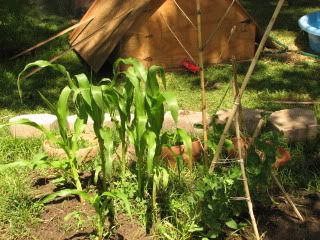
Good news: The mound for my corn, beans, and squash doesn't seem to have been infected by the wilt that got my zucchini -
Bad news: The bush peas I planted have given maybe 10 peas, and they don't look like they'll do much more...
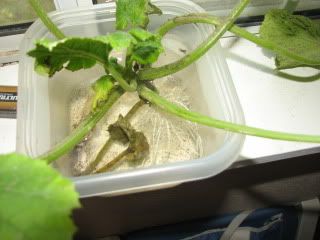
Good news: that zucchini I tried to save has rooted somethin' fierce, and I'll be planting it in a pot with soil from the store -
Bad news: ... none, I hope.
Tuesday, May 12, 2009
Many, many slugs

And for that, I'm now much more thankful than I was a month ago. You see, I've been picking slugs for the past month, a few here, a few there, and feeding them to my ducklings. I've identified at least three visually distinct varieties, and I've found out that most slugs in my garden are around 2 mm. in length - tiny boogers, and most likely the reason many of my plants look like they've been hit with a shotgun.
Anyhoo, four days ago, I mowed down the edges of the garden and moved a bunch of stuff. The edges had high grasses and some old wood and such, and I picked a few slugs as I moved things. After mowing, Phoebe and I placed some cardboard strips along the edge of the garden, and the next day turned them to find MANY, MANY slugs. I didn't count, but grabbed a few at a time and fed them to the ducklings. The second day, the same thing occurred. I estimated maybe fifty slugs at a time, but yesterday, to be sure, I counted.
On the third day of slug gathering... 111 slugs. And, I know I had more the previous days. This morning, the initial gathering brought 28 more slugs, and I haven't yet checked all the sites.
And I need to do more. I have to pull the grasses out of the garden, as the slugs are using the bases of those plants to hide out under the dirt during the day. If I remove that as an option, they will have to go to the cardboard. Hopefully, I will see a dramatic improvement soon.
Tuesday, May 5, 2009
A new pest problem, the need for a few pests, & my vermicultural experiment begun
Here is a photo of some damage from a pest that can be beneficial to your garden, but if left unchecked can wreak some serious carnage upon your greens:
 This is my spinach, coming along nicely except for the large, ragged holes and torn pieces. We'll get back to it in a minute, so try to figure out the particular pest.
It is nice to have some pests like aphids around,
and here is why:
The benefits of ladybugs only accrue if they have something to eat. Here this little critter is walking on my brandywine tomato plant, looking to kill something.
Ladybugs have at least two grand purposes in our garden. First, they kill many plant pests. Second, and just as important, their bright coloration makes it easy for our daughter to spot them and get all excited.
However, if we had sprayed the entire garden with pesticide, no matter how "green", we would not have the opportunity to see these great little beetles. They would have checked out the place, found it barren and hostile, and bugged out or worse. Now, because we had some aphids and such, we can always find a few ladybird beetles out and about on our plants. Our plants do not look worse for the wear, either.
It's about balance and trust. If we steward these things, watching for cues from the activities around us rather than trying to muscle in and put everything in its place, then we get surprises we hadn't expected, or had anticipated.
Which brings me to my vermiculture experiment. Last year, I realized I wasn't going to be able to get a hot compost pile going. I just don't get it, and I also think I just don't have the property size to sacrifice for it plus the garbage waiting its turn. So this year, I decided to try a compost bin. I didn't want to go big to begin, so I bought to 18 gallon Sterilite tubs, punched holes in one. shook it every couple of days while I added material to it. I overdid the nitrogen, of course, because it got slimy and buggy. I wasn't getting that one, either.
So now, I'm trying worms. I filled about 4/5th's of the holey tub with straw from the ducklings' bedding, buried it about 1/2 way into the ground behind the garden, and threw in 100 red worms from the local bait shop. I've since added coffee grounds and some green scraps, as well as some composting leaves from a pile from last year.
At first, I'd seen many little flies, but in the past couple of days they have dropped off. But, so has the temperature, so that may not be due to the worms. I do think I need more worms, and will purchase some shortly. I'll also try to keep folks posted here as to the relative success of this composting attempt.
Okay, back to the quiz. Have you figured out the pest that, if left unchecked, can wreak devastation to make a slug green with envy? It is none other than that ravenous Anas platyrhynchos...
 This is my spinach, coming along nicely except for the large, ragged holes and torn pieces. We'll get back to it in a minute, so try to figure out the particular pest.
It is nice to have some pests like aphids around,
and here is why:

The benefits of ladybugs only accrue if they have something to eat. Here this little critter is walking on my brandywine tomato plant, looking to kill something.
Ladybugs have at least two grand purposes in our garden. First, they kill many plant pests. Second, and just as important, their bright coloration makes it easy for our daughter to spot them and get all excited.
However, if we had sprayed the entire garden with pesticide, no matter how "green", we would not have the opportunity to see these great little beetles. They would have checked out the place, found it barren and hostile, and bugged out or worse. Now, because we had some aphids and such, we can always find a few ladybird beetles out and about on our plants. Our plants do not look worse for the wear, either.
It's about balance and trust. If we steward these things, watching for cues from the activities around us rather than trying to muscle in and put everything in its place, then we get surprises we hadn't expected, or had anticipated.
Which brings me to my vermiculture experiment. Last year, I realized I wasn't going to be able to get a hot compost pile going. I just don't get it, and I also think I just don't have the property size to sacrifice for it plus the garbage waiting its turn. So this year, I decided to try a compost bin. I didn't want to go big to begin, so I bought to 18 gallon Sterilite tubs, punched holes in one. shook it every couple of days while I added material to it. I overdid the nitrogen, of course, because it got slimy and buggy. I wasn't getting that one, either.
So now, I'm trying worms. I filled about 4/5th's of the holey tub with straw from the ducklings' bedding, buried it about 1/2 way into the ground behind the garden, and threw in 100 red worms from the local bait shop. I've since added coffee grounds and some green scraps, as well as some composting leaves from a pile from last year.
At first, I'd seen many little flies, but in the past couple of days they have dropped off. But, so has the temperature, so that may not be due to the worms. I do think I need more worms, and will purchase some shortly. I'll also try to keep folks posted here as to the relative success of this composting attempt.
Okay, back to the quiz. Have you figured out the pest that, if left unchecked, can wreak devastation to make a slug green with envy? It is none other than that ravenous Anas platyrhynchos...

Saturday, May 2, 2009
Dying squash and cucumber

Well, it's happening again: I'm losing my zucchinis and cucumbers to some unknown ailment.
Last week, I looked down at the base of my zucchini plant, and I saw the signs of a wilting that occurred last year:

The plant grows vigorously for a few weeks, and then begins to shrivel up where the stem comes out from the ground. This shriveling then follows the plant up and out, killing the vines and leaves. The plant grows vigorously, flowering big, beautiful flowers, but before it can become a fruit, the shriveling catches up with it and it dies.
In my garden, no other plant last year was affected by this mystery disease. And this year, it looks like it's just the zucchini so far (though the cucumbers have shown some yellowing). Now, it has occurred after a hot snap we had (96 degrees for a couple of days), and I've read that bacterial and verticillium wilts may occur after the temeratures rise, but again, no other plants have shown this damage.
I'm suspecting a squash borer, but by the pictures I took this morning, I don't see any signs, and I'm loathe to pull such a beautiful plant. What I am going to do, instead, is cut it above the withering, and put it in some water. If/when it roots, I'll plant it in fresh soil and see if that solves the problem.
If you have any suggestions or, better yet, THE answer to my problem, please let me know.
Friday, April 24, 2009
My setup
As a first post about my garden, growing things and raising things (right now ducks and plants) on 1/10th acre total, I guess I should start with a list of what we have, so far:
Sweet corn, pole beans, bush beans, radishes, broccoli, spinach, swiss chard, nasturtium, cucumbers, peppers, potatoes, carrots, cabbage, onions, leeks, garlic, zucchini, tomatoes, boysenberry, orange, pomegranate, parsley, sage, dill, thyme, basil, oregano, strawberries, walnuts, ducks, cedar, redwood, roses.
My goal right now is for one meal per week to come completely from our little space. We live on a 1/10th acre lot in a city near Sacramento, worked a little garden space last year for tomatoes, squash, cucumbers, corn, beans, and peppers, and watched the soil bloom with worms and oxalis. This year, the soil looked much better, although the plants still grew well last year, with the notable exception of the squash and cucumbers.
Those two plants were beset by some disease which rotted the plants right at flowering time. The plants would grow and flower prolifically, but just as the flowers turned to fruit, the vine had shriveled up to it, and killed it. Exactly one cucumber and one zucchini last year, the former inedible, the latter shaped like a baseball bat.
So, I'm hoping this year that the better soil will prevent that, and if it does not, then I'll have to do some research.
Sweet corn, pole beans, bush beans, radishes, broccoli, spinach, swiss chard, nasturtium, cucumbers, peppers, potatoes, carrots, cabbage, onions, leeks, garlic, zucchini, tomatoes, boysenberry, orange, pomegranate, parsley, sage, dill, thyme, basil, oregano, strawberries, walnuts, ducks, cedar, redwood, roses.
My goal right now is for one meal per week to come completely from our little space. We live on a 1/10th acre lot in a city near Sacramento, worked a little garden space last year for tomatoes, squash, cucumbers, corn, beans, and peppers, and watched the soil bloom with worms and oxalis. This year, the soil looked much better, although the plants still grew well last year, with the notable exception of the squash and cucumbers.
Those two plants were beset by some disease which rotted the plants right at flowering time. The plants would grow and flower prolifically, but just as the flowers turned to fruit, the vine had shriveled up to it, and killed it. Exactly one cucumber and one zucchini last year, the former inedible, the latter shaped like a baseball bat.
So, I'm hoping this year that the better soil will prevent that, and if it does not, then I'll have to do some research.
Subscribe to:
Posts (Atom)