Last week, I caught my first American shad on the American river (you can read that story at my Enviroethics blog). Right now, the cleaned fish is in our freezer, awaiting the day I will have enough time to either have built a smoker from Alton Brown's idea, or enough courage to try Hank Shaw's inspired honegiri method for taking care of the bones.
However, I did try a recipe from John McPhee's book "Founding Fish." Really, it wasn't a recipe, as much as, "roll it in some flour, salt and pepper it, and fry it like an egg." And American shad are known for their eggs, called roe. But I caught a buck shad, so no roe.
Yep, I ate that.
Shad milt. And it was good, although the consistency was a tad too reminiscent of fried eggs for my taste. Actually, it was a bit anticlimactic, as it tasted like really, really good, subtle fish, and nothing else. Actually, as far as a fish taste goes, it was just about perfect.
I'll eat more in the future, I'm sure, and if people can get over the idea, and if they like egg consistency (which most do), then this is a great meal, a special meal.
Can you do it?

Sunday, May 31, 2009

Monday, May 18, 2009
The first real harvest (and another first)
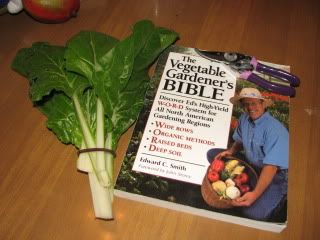 We cut a serving's worth of swiss chard a couple of days ago. Unfortunately, it quickly wilted in the fridge even in water, so next time I'll remember to cut the chard when we are going to eat it that day. These will get turned into compost and give our ducks reason to jump into the pool today.
 I included the purple shears and the "Vegetable Gardener's Bible" in this picture because the shears were used in the harvest (a nice pair that fits my wife), and the book has been my staple for planting my garden this year. Hopefully, when the ducks start laying eggs, I'll get a picture with them and "Five Acres and Independence", which was helpful in getting me to try livestock.
And speaking of livestock: Yesterday the ducklings took to the pool. It took them quite a while, and 100 degree temperatures, but after putting some cabbage on the step to the edge of the pool, and then some cabbage and dandelion greens into the pool water, they reeeeached out their necks to get as many as they could, drank a bit, and then... one of 'em dove in like an olympic swimmer! Straight under the water, and then around and around the pool, completely submerged, with her legs stuck straight out behind her! Then the other two jumped in, and that, as they say, was that. Our ducks love water, and were in the pool yesterday for hours. Today I'll get some pictures of them.
Sunday, May 17, 2009
The Good News/Bad News post
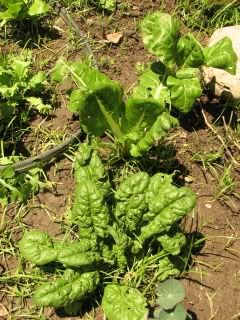
Good News: My spinach and greens, well actually most everything in the garden, is taking off -
Bad News: My swiss chard languishes in the Sun and doesn't keep in the fridge...
If you have any suggestions for getting my chard to perk up, please let me know. It isn't for a lack of water.
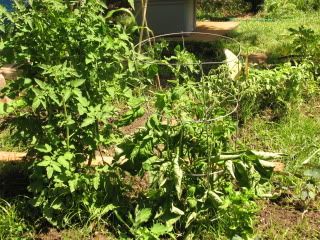 Good news: My tomatoes are about five feet high
Bad news: My brandywine's largest leaves are curling, and it doesn't look like it'll be very prolific:
Let me know if you think I should plant another tomato to take its place... Will it produce early and then die, or keep producing through the Summer?
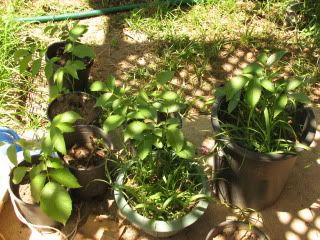
Good news: Our potted walnuts, babies from our 65 foot tree, look really great!
Bad news: Nobody wants them :( I've tried posting them to Craigslist, but I get the impression that the only people asking about them wanted dozens. Maybe next year...
If you are interested in a walnut tree, please let me know.
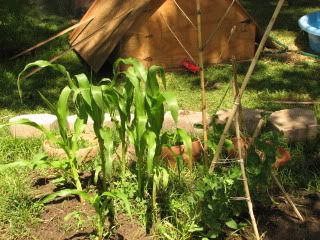
Good news: The mound for my corn, beans, and squash doesn't seem to have been infected by the wilt that got my zucchini -
Bad news: The bush peas I planted have given maybe 10 peas, and they don't look like they'll do much more...
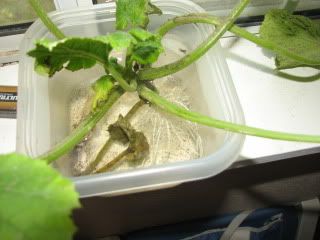
Good news: that zucchini I tried to save has rooted somethin' fierce, and I'll be planting it in a pot with soil from the store -
Bad news: ... none, I hope.
Thursday, May 14, 2009
New digs - The First Iteration of our Duck Ark
Well, yesterday I spent a good chunk of time putting this together...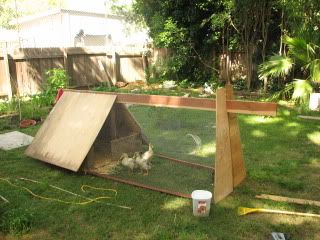 As the biggest hurdle for this housing unit was cost, I owe a big thanks to Craigslist. The only direct purchases for this were the wire mesh (1/2" aviary netting, $1.70/ft. at 48" wide), the 2x6 redwood roof beam, hinges for the roof, and corner brackets for the walls.
I had originally planned to photograph the process and offer a play-by-play, but that is a drag by oneself. Also, it got pretty embarrassing a couple of times, considering my carpenter's motto: Measure once, cut twice!
The ducks spent their first night outdoors in their new home, and were much happier and more content than I was. This morning, when Irma barked, I jumped out of bed to make sure she wasn't barking at the cat that had gotten in and slaughtered the three sisters. But, they were fine. Of course, when they saw me, they commenced to quack/squealing for breakfast...
This house is designed to be moved around the yard every day or two, allowing the ducks to get to fresh forage and to evenly distribute their compost in the yard. This first version has a couple of flaws, one of which is that I can't get in without unscrewing something, so today I build an adequate means of entry that also provides security...
I also learned that I LOVE my bandsaw...
 I bought this last year at Lowe's. It was the floor model, the last they had, and it was marked down from $180 to $90, but after noting some missing pieces (none dangerous), I walked out of the store with it for $75. The first thing I did with it was resaw some old 2x4 redwood pieces I had, and it cut them like butter and straight enough for me (my other carpenter's motto: I ain't building a piano).
So, with the duck house near completion, the ducks are officially outside animals. I hope they don't get eaten...
As the biggest hurdle for this housing unit was cost, I owe a big thanks to Craigslist. The only direct purchases for this were the wire mesh (1/2" aviary netting, $1.70/ft. at 48" wide), the 2x6 redwood roof beam, hinges for the roof, and corner brackets for the walls.I had originally planned to photograph the process and offer a play-by-play, but that is a drag by oneself. Also, it got pretty embarrassing a couple of times, considering my carpenter's motto: Measure once, cut twice!
The ducks spent their first night outdoors in their new home, and were much happier and more content than I was. This morning, when Irma barked, I jumped out of bed to make sure she wasn't barking at the cat that had gotten in and slaughtered the three sisters. But, they were fine. Of course, when they saw me, they commenced to quack/squealing for breakfast...
This house is designed to be moved around the yard every day or two, allowing the ducks to get to fresh forage and to evenly distribute their compost in the yard. This first version has a couple of flaws, one of which is that I can't get in without unscrewing something, so today I build an adequate means of entry that also provides security...
I also learned that I LOVE my bandsaw...
 I bought this last year at Lowe's. It was the floor model, the last they had, and it was marked down from $180 to $90, but after noting some missing pieces (none dangerous), I walked out of the store with it for $75. The first thing I did with it was resaw some old 2x4 redwood pieces I had, and it cut them like butter and straight enough for me (my other carpenter's motto: I ain't building a piano).
 So, with the duck house near completion, the ducks are officially outside animals. I hope they don't get eaten...
Tuesday, May 12, 2009
Many, many slugs

And for that, I'm now much more thankful than I was a month ago. You see, I've been picking slugs for the past month, a few here, a few there, and feeding them to my ducklings. I've identified at least three visually distinct varieties, and I've found out that most slugs in my garden are around 2 mm. in length - tiny boogers, and most likely the reason many of my plants look like they've been hit with a shotgun.
Anyhoo, four days ago, I mowed down the edges of the garden and moved a bunch of stuff. The edges had high grasses and some old wood and such, and I picked a few slugs as I moved things. After mowing, Phoebe and I placed some cardboard strips along the edge of the garden, and the next day turned them to find MANY, MANY slugs. I didn't count, but grabbed a few at a time and fed them to the ducklings. The second day, the same thing occurred. I estimated maybe fifty slugs at a time, but yesterday, to be sure, I counted.
On the third day of slug gathering... 111 slugs. And, I know I had more the previous days. This morning, the initial gathering brought 28 more slugs, and I haven't yet checked all the sites.
And I need to do more. I have to pull the grasses out of the garden, as the slugs are using the bases of those plants to hide out under the dirt during the day. If I remove that as an option, they will have to go to the cardboard. Hopefully, I will see a dramatic improvement soon.
Wednesday, May 6, 2009
So... how might one harvest from this?
I'm watching some green walnuts falling off my tree, lately. They are usually bird-pecked or squirrel-bitten, and they are very tiny, say, 3/4 to 1 inch diameter.
However, I've found out that a few things can be made from green walnuts, sent to me by my good friend Kari Kiser over at The Erratic Sewer and Crafter, and I hope to at least make a syrupy candy out of a few of them. I have no idea how it will taste.
My looming problem, then, is how to harvest from a 65 foot walnut with a lower canopy at least 15 feet off the ground...

Any suggestions would be appreciated, but they cannot include A) sprouting wings, B) training my ducks, dog, family members to fly and harvest, C) hugging the tree and shaking vigorously, or D) any form of hired help.
However, I've found out that a few things can be made from green walnuts, sent to me by my good friend Kari Kiser over at The Erratic Sewer and Crafter, and I hope to at least make a syrupy candy out of a few of them. I have no idea how it will taste.
My looming problem, then, is how to harvest from a 65 foot walnut with a lower canopy at least 15 feet off the ground...

Any suggestions would be appreciated, but they cannot include A) sprouting wings, B) training my ducks, dog, family members to fly and harvest, C) hugging the tree and shaking vigorously, or D) any form of hired help.
Tuesday, May 5, 2009
A new pest problem, the need for a few pests, & my vermicultural experiment begun
Here is a photo of some damage from a pest that can be beneficial to your garden, but if left unchecked can wreak some serious carnage upon your greens:
 This is my spinach, coming along nicely except for the large, ragged holes and torn pieces. We'll get back to it in a minute, so try to figure out the particular pest.
It is nice to have some pests like aphids around,
and here is why:
The benefits of ladybugs only accrue if they have something to eat. Here this little critter is walking on my brandywine tomato plant, looking to kill something.
Ladybugs have at least two grand purposes in our garden. First, they kill many plant pests. Second, and just as important, their bright coloration makes it easy for our daughter to spot them and get all excited.
However, if we had sprayed the entire garden with pesticide, no matter how "green", we would not have the opportunity to see these great little beetles. They would have checked out the place, found it barren and hostile, and bugged out or worse. Now, because we had some aphids and such, we can always find a few ladybird beetles out and about on our plants. Our plants do not look worse for the wear, either.
It's about balance and trust. If we steward these things, watching for cues from the activities around us rather than trying to muscle in and put everything in its place, then we get surprises we hadn't expected, or had anticipated.
Which brings me to my vermiculture experiment. Last year, I realized I wasn't going to be able to get a hot compost pile going. I just don't get it, and I also think I just don't have the property size to sacrifice for it plus the garbage waiting its turn. So this year, I decided to try a compost bin. I didn't want to go big to begin, so I bought to 18 gallon Sterilite tubs, punched holes in one. shook it every couple of days while I added material to it. I overdid the nitrogen, of course, because it got slimy and buggy. I wasn't getting that one, either.
So now, I'm trying worms. I filled about 4/5th's of the holey tub with straw from the ducklings' bedding, buried it about 1/2 way into the ground behind the garden, and threw in 100 red worms from the local bait shop. I've since added coffee grounds and some green scraps, as well as some composting leaves from a pile from last year.
At first, I'd seen many little flies, but in the past couple of days they have dropped off. But, so has the temperature, so that may not be due to the worms. I do think I need more worms, and will purchase some shortly. I'll also try to keep folks posted here as to the relative success of this composting attempt.
Okay, back to the quiz. Have you figured out the pest that, if left unchecked, can wreak devastation to make a slug green with envy? It is none other than that ravenous Anas platyrhynchos...
 This is my spinach, coming along nicely except for the large, ragged holes and torn pieces. We'll get back to it in a minute, so try to figure out the particular pest.
It is nice to have some pests like aphids around,
and here is why:

The benefits of ladybugs only accrue if they have something to eat. Here this little critter is walking on my brandywine tomato plant, looking to kill something.
Ladybugs have at least two grand purposes in our garden. First, they kill many plant pests. Second, and just as important, their bright coloration makes it easy for our daughter to spot them and get all excited.
However, if we had sprayed the entire garden with pesticide, no matter how "green", we would not have the opportunity to see these great little beetles. They would have checked out the place, found it barren and hostile, and bugged out or worse. Now, because we had some aphids and such, we can always find a few ladybird beetles out and about on our plants. Our plants do not look worse for the wear, either.
It's about balance and trust. If we steward these things, watching for cues from the activities around us rather than trying to muscle in and put everything in its place, then we get surprises we hadn't expected, or had anticipated.
Which brings me to my vermiculture experiment. Last year, I realized I wasn't going to be able to get a hot compost pile going. I just don't get it, and I also think I just don't have the property size to sacrifice for it plus the garbage waiting its turn. So this year, I decided to try a compost bin. I didn't want to go big to begin, so I bought to 18 gallon Sterilite tubs, punched holes in one. shook it every couple of days while I added material to it. I overdid the nitrogen, of course, because it got slimy and buggy. I wasn't getting that one, either.
So now, I'm trying worms. I filled about 4/5th's of the holey tub with straw from the ducklings' bedding, buried it about 1/2 way into the ground behind the garden, and threw in 100 red worms from the local bait shop. I've since added coffee grounds and some green scraps, as well as some composting leaves from a pile from last year.
At first, I'd seen many little flies, but in the past couple of days they have dropped off. But, so has the temperature, so that may not be due to the worms. I do think I need more worms, and will purchase some shortly. I'll also try to keep folks posted here as to the relative success of this composting attempt.
Okay, back to the quiz. Have you figured out the pest that, if left unchecked, can wreak devastation to make a slug green with envy? It is none other than that ravenous Anas platyrhynchos...

Saturday, May 2, 2009
Dying squash and cucumber

Well, it's happening again: I'm losing my zucchinis and cucumbers to some unknown ailment.
Last week, I looked down at the base of my zucchini plant, and I saw the signs of a wilting that occurred last year:

The plant grows vigorously for a few weeks, and then begins to shrivel up where the stem comes out from the ground. This shriveling then follows the plant up and out, killing the vines and leaves. The plant grows vigorously, flowering big, beautiful flowers, but before it can become a fruit, the shriveling catches up with it and it dies.
In my garden, no other plant last year was affected by this mystery disease. And this year, it looks like it's just the zucchini so far (though the cucumbers have shown some yellowing). Now, it has occurred after a hot snap we had (96 degrees for a couple of days), and I've read that bacterial and verticillium wilts may occur after the temeratures rise, but again, no other plants have shown this damage.
I'm suspecting a squash borer, but by the pictures I took this morning, I don't see any signs, and I'm loathe to pull such a beautiful plant. What I am going to do, instead, is cut it above the withering, and put it in some water. If/when it roots, I'll plant it in fresh soil and see if that solves the problem.
If you have any suggestions or, better yet, THE answer to my problem, please let me know.
Subscribe to:
Posts (Atom)